Formula (Main window)
Basic example
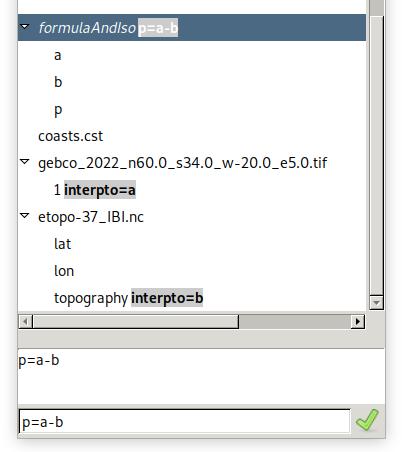
Simple calculation can be made by assigning a formula to p (or u and v). Open the two files in the directory “bathymetry”:
Primary menu → formulatAndIso, then Secondary menu → p = a - b
Primary menu → etopo-37_IBI.nc → topography, then Secondary menu → a → interp
Primary menu → gebco_[…].tif → 1, then Secondary menu → b → interp
Native functions and variables
Some functions are already coded, the calculation of the slope can be with the two following methods:
Primary menu → formulatAndIso, then Secondary menu
→ p = ( gradx(p0)^2 + grady(p0)^2 )^0.5
→ p = ellipseM( gradx(p0) , grady(p0) )
Primary menu → etopo-37_IBI.nc → topography, then Secondary menu → p0 → interp
Operators
Name |
Description |
|---|---|
|
Addition, difference, product, ratio, power, scalar product |
|
Comparison operator (return 0 or 1) |
|
Merge the fields of different variables |
Variables
Name |
Description |
|---|---|
|
Degree to radian (π/180) |
|
Exponential |
|
Not a number |
|
π |
|
Radian to degree (180/π) |
|
Latitude over the view |
|
Longitude over the view |
|
Variable that displays a gridded field |
|
Variable that displays a gridded zonal velocity (quiver) |
|
Variable that displays a gridded meridional velocity (quiver) |
|
Variable that displays a pixel cloud |
|
Landmask |
|
Mask of the plotted variable [ p or (u,v) ] |
If |
|
If |
|
Gradient of white mask between 0-1 |
|
|
Value of the variable |
|
Interpolation of the variable at the location between index 4445 and 4446 |
Functions
Name |
Description |
|---|---|
|
Norm (real or complex) |
|
Phase lag (complex) |
|
Cosine |
|
Exponential |
|
Zonal gradient |
|
Meridian gradient |
|
Sine |
|
Hyperbolic sine |
|
Convert Julian days since 1950 to date format (e.g., |
|
Convert date format (e.g., |
|
Zonal difference to the neighbor pixel |
|
Meridian difference to the neighbor pixel |
|
Flip along x-axis |
|
Flip along y-axis |
|
Interpolate the masked value with the nearest one |
|
Cumulative distance along a polygon |
|
Norm of vector or maximum current of ellipse |